Planning an African safari in a practical order
A first safari is easier to organize when you make a few decisions before asking for offers. Tell a planner who is traveling, what matters most and which dates are fixed.
Count usable nights at the wildlife destination separately from international flights and arrival stays. Then identify one main area and a possible second stop. Add another park only when it changes the experience enough to justify the transfer.
| Step | Decision to make | What to obtain |
|---|---|---|
| 1 | Main wildlife interest | A destination and region shortlist |
| 2 | Month and trip length | Nights at each base |
| 3 | Self-drive or guided | Responsibilities and vehicle arrangements |
| 4 | Budget | Whole-trip limit and priorities |
| 5 | Planner or direct booking | Payment model and support |
| 6 | Quote comparison | Matching inclusions and cancellation terms |
| 7 | Entry and health checks | Passport-specific and route-specific preparation |
| 8 | Payment | Confirmed dates, suppliers and emergency contact |
Use the order to avoid comparing packages that provide different amounts of wildlife time.
Choose a safari style before the country
A self-drive safari suits travelers who enjoy choosing the route and taking responsibility for fuel, meals and timing. Kruger is a useful starting point because SANParks provides tourist roads and rest camps.
A guided road safari can combine a driver-guide, vehicle and several overnight stops.
A fly-in lodge stay can reduce one road journey while adding flight and airstrip-transfer costs. A short flight does not establish the time you reach the room.
A shared departure and a private itinerary serve different priorities. Compare seating, the number of travelers and flexibility over stops. The Kruger versus Serengeti guide explains the independent and guided choices in more detail.
Pick the park area for the month
Start with the actual place where you will sleep. In a large ecosystem, the park name can cover very different habitats and access routes.
TANAPA describes the Serengeti’s broad dry season as May to October. Those patterns are useful starting points, with the final camp choice based on your interests and dates.
Avoid making the trip depend on a single crossing. Wildlife behavior does not follow a fixed departure schedule.
For a first route, several nights in one well-chosen area can provide more time for viewing than moving every day. The Kenya destination guide and Tanzania destination guide help identify contrasting options.
For a migration trip, January-March points toward the southern Serengeti/Ndutu ecosystem, June-July toward western and northbound routes, and July-October toward the northern Serengeti and Mara. In Kruger, June-August commonly brings afternoons around 25°C (77°F), with cold open-vehicle mornings. The dry-season landscape and the warmer, greener summer are different wildlife settings rather than interchangeable dates at the same camp.
How safari agents and operators are paid
An agent sells or coordinates services from suppliers; an operator delivers the ground itinerary or packages those services. The payment model affects who receives your money and who handles a cancellation. It does not by itself establish whether a direct booking is cheaper.
As of November 2026, Go2Africa receives supplier commissions or fees already built into supplier rates. Its planning service therefore does not add a separate charge under that stated model. The complete package still pays for accommodation, guiding, transfers and other included services.
As of November 2026, Global Compass Tours charges a separately agreed planning/service fee when you proceed with its proposed Tanzania itinerary. Safari deposits and balances go directly to the named local operator, which provides accommodation, guide, vehicle and activities. The planning fee and the safari payment are distinct transactions. Global Compass sells private Tanzania safaris, so its dedicated vehicle model should not be compared as though it were an open group departure.
| Planner | Deposit arrangement as of November 2026 | Balance terms | Important exception |
|---|---|---|---|
| Go2Africa | Normally 30% at booking | Due 60 days before travel | Flights paid in full; villas normally 50% deposit; bookings inside 60 days paid in full |
| Global Compass Tours, Tanzania | Local operator typically requests around 30%, paid directly to that operator | Due date set in the local operator’s booking terms | Separate planning fee is agreed with Global Compass; no universal balance deadline is published |
Go2Africa also requires full payment for primate permits to secure them, and specialist or peak-season products can require larger deposits. Global Compass’s Tanzania terms must not be replaced with the different 50% arrangement on its Northern Pakistan section. These are two company examples rather than a market-wide rule about every safari business.
Safari travel agent fees and what to expect
There is no universal safari travel agent fee or standard consulting percentage. A supplier-funded agent and a planner with a separate service fee can both provide useful coordination, but the total price and contract determine the value. The Go2Africa model above embeds supplier remuneration in rates; Global Compass separates its planning payment from the local operator’s holiday payment.
| Cost line | What it buys | Why it changes the comparison |
|---|---|---|
| Planning/service fee | Itinerary design and advice | May be separate from the safari contract |
| Accommodation | A named room, tent or campsite | Occupancy and meal plan change the total |
| Guide and vehicle | Private or shared wildlife transport | Six travelers sharing differs from a couple’s private vehicle |
| Authority charges | Park, reserve or conservancy access | Charged by person, day or permit category |
| Regional flights | Airport-to-airstrip travel | Luggage rules and camp transfers remain separate |
| Amendments/cancellation | Changes to an accepted booking | Supplier and planner charges can both apply |
For example, two travelers wanting exclusive use of a vehicle carry its cost between them, while six on a shared departure spread that cost more widely. The nominal room tier does not explain that difference. A written quote needs the actual passenger count and vehicle arrangement, not simply the phrase safari included.
Go2Africa’s published booking terms distinguish deposits from later cancellation liability. A deposit is not a promise that cancellation can never cost more than that amount. Global Compass’s local operator supplies its own cancellation schedule for the Tanzania ground services, so a single generic deadline cannot describe both businesses.
Build the budget from the complete service
Compare accommodation, meals, guide, vehicle, park or conservancy charges and transfers. Add international and regional flights where they are separate. Include arrival accommodation and any road transfer needed before the first safari night.
State every child’s age at travel. Room allocation and activity eligibility can affect both the price and the available itinerary.
For a self-drive route, add vehicle hire, fuel, food and separately booked activities to the camp rate. An all-inclusive description still needs an itemized explanation.
Use one comparison sheet with the same dates and traveler count. Mark each item as included, excluded or unclear. Resolve the unclear entries before deciding that one quote offers better value.
A verified fee example from Kruger
Park charges are useful anchors for the budget because they identify a real expense separately from hotel quality. The following examples are as of November 2026 and apply to the stated foreign-visitor categories. They exclude accommodation, vehicles and additional activities.
| Authority and category | Entrance/conservation amount | Validity or season |
|---|---|---|
| Kruger, international adult 12+ | R692 daily | November 1, 2026-October 31, 2027 |
| Kruger, international child 2-11 | R345 daily | Same tariff period |
| Maasai Mara, non-resident adult | USD100 daily January-June; USD200 daily July-December | As of November 2026; Narok seasonal schedule |
| Maasai Mara, non-resident child 9-17 | USD50 daily | Children eight and younger free |
| Serengeti, non-resident adult | TZS178,850 high-season entrance | May 16, 2026-March 14, 2027 |
Kruger has separate South African citizen/resident and SADC rates. The Mara charge is a reserve fee, not a Kenya Wildlife Service national park tariff or an automatic conservancy payment. Serengeti entrance is separate from camping/concession and vehicle charges. Those distinctions matter when a package claims that park fees are included.
For a simple worked example, two non-resident adults spending three Mara reserve days incur USD600 in January-June or USD1,200 in July-December before vehicle and accommodation. This is arithmetic from the authority’s seasonal rate, not a safari package quote. Adding a reserve excursion to a conservancy stay can add a different charge from remaining in the conservancy all day.
Booking lead times and the contract
Keep the names and emergency contacts in the final itinerary.
Financial protection and on-trip support are different services.
Pay against the accepted itinerary and terms. A conversation about a different camp should not leave the final confirmation ambiguous.
For peak-season groups and small high-demand camps, start about 12-18 months ahead. Outside peak periods, six to nine months is a useful normal planning window. These are booking lead-time guides rather than availability guarantees. July-October migration trips and school-holiday dates need earlier decisions because the preferred region, camp and vehicle all have to line up.
A suggested sequence is to settle the wildlife region and dates first, then secure the controlling camp or permit, then align regional flights and arrival accommodation. A three-month planning window can still produce a workable safari, but flexibility over the exact camp and region becomes more valuable. The deposit schedule is a payment rule, not the same thing as the recommended time to begin planning.
Inspect the daily itinerary
A typical guided safari day starts with a morning wildlife drive, pauses around lunch and goes out again later, or uses a longer drive with a packed lunch. The main practical distinction is a full day at the wildlife base versus an arrival or departure day. Four camp nights normally produce three complete intervening days, with partial outings dependent on transport timing.
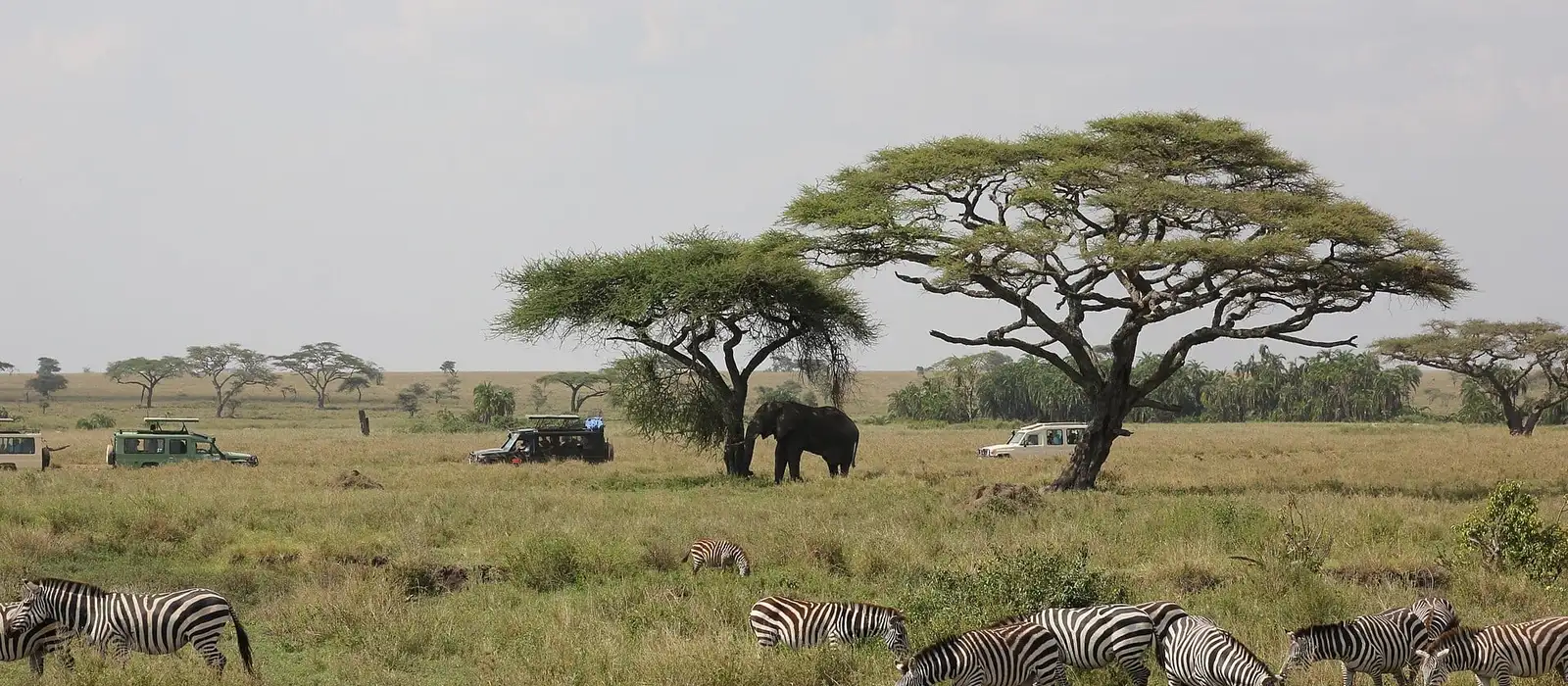
East African road safaris commonly use a 4x4 Land Cruiser with a pop-up viewing roof; shared departures often cap occupancy at six guests. Southern African lodge drives commonly use open 4x4 vehicles with rows of raised seats. Six guests can mean two per row, while a nine-seat arrangement fills the middle positions as well. These are common configurations, not one rule applied to every operator.
For photography, exclusive use changes the ability to wait at a sighting and the space available for equipment. For a family, it changes the pace without requiring the entire shared group to return early. Global Compass’s Tanzania model dedicates the vehicle and guide to your party; an advertised shared departure is a different product even if it visits the same parks.
Transfer time deserves its own line. Johannesburg-Skukuza takes about an hour by air, while Johannesburg-Malelane Gate is 428 km (266 miles) and roughly five to six hours by road before in-park driving. Arusha-Serengeti light-aircraft services take roughly one hour 10 minutes to two hours depending on stops. These are transport stages, and a flight ending at an airstrip still leaves a drive to camp.
The South Africa versus Tanzania comparison helps place those days within a wider holiday. A beach extension should leave several actual nights at the beach after its flight and hotel transfer, rather than turning the last portion of the trip into a sequence of airports.
Entry, health and insurance checks
As of November 2026, Kenya requires government-provided travel health insurance for most qualifying visitors staying under 12 months, alongside any required eTA. Exemptions apply by citizenship, residence and transit status. New eTA applicants buy the policy in the application, while existing eTA holders use eCitizen; foreign insurance does not replace it.
As of November 2026, Tanzania’s inbound insurance follows the first port of entry: NIC for mainland-first arrivals and ZIC for Zanzibar-first arrivals. The transition for ZIC cover bought before October 1 remains relevant. Residents are exempt, and a mainland-Zanzibar route does not itself require buying the first-entry policy twice.
Kruger is a malaria-risk area; Cape Town lies outside known transmission areas in the CDC’s November 2026 guidance. The Tanzania and Kenya park-and-coast routes need their own assessment. See a travel clinic with the complete overnight route. Confirm current passport and entry rules before travel, since operator booking terms do not decide immigration eligibility.
Decide what to reduce before cutting essential time
Fewer parks, a simpler room or a shared departure may help. A shorter transfer chain can also preserve more time at the wildlife destination.
Avoid reducing every stay to a single night simply to retain every destination. Compare the money saved with the wildlife time gained.
If you prioritize photography, discuss the vehicle before upgrading the room. Make those preferences clear so the planner can make useful trade-offs.
Keep optional activities separate until the core route works. A balloon flight or another premium excursion may be appealing, but it should not obscure the price of the safari you came to take.
Final booking checklist
Keep these details together before payment:
- The named wildlife region and camp, including a seasonal camp’s location.
- Private or shared vehicle use, with the maximum guest count stated.
- Park fees by age, nationality and travel date.
- The deposit recipient and balance deadline from the applicable contract.
- Passport, insurance and travel-clinic preparation for the full route.
For Go2Africa, the normal balance falls 60 days before travel. For Global Compass’s Tanzania model, the local operator supplies that deadline. The Africa planning guide coordinates the safari with a city or island extension.
Frequently asked questions
What is the usual safari travel agent fee?
There is no universal separate fee or standard percentage. Go2Africa uses supplier-funded remuneration under its published model, while Global Compass Tours agrees a separate planning fee for its Tanzania service.
What deposit and balance terms do the two planners use?
As of November 2026, Go2Africa normally requires a 30% deposit and the balance 60 days before travel, with exceptions for flights, villas and late bookings. Global Compass's Tanzania local operator typically takes around 30% directly and sets the balance schedule in that operator's terms.
How far ahead should you book a first safari?
About 12-18 months is a useful guide for peak-season groups and small high-demand camps. Six to nine months is a normal starting window outside peak periods, with actual availability deciding the final route.
How many people share a safari vehicle?
Shared East African departures often cap vehicles at six guests, while configurations vary by operator and lodge. A private itinerary dedicates the vehicle to your party, which changes both per-person cost and flexibility.
What should a safari quote include?
It should name the accommodation, meal plan, guide, vehicle, authority charges and transfers. International flights, visas, mandatory insurance and optional activities need separate lines when excluded.
Sources
- Go2Africa – general FAQ and revenue model go2africa.com
- SANParks – Kruger visitor tips sanparks.org
- SANParks – Kruger fees sanparks.org
- SANParks – Kruger climate sanparks.org
- TANAPA – Serengeti information tanzaniaparks.go.tz
- FCDO – Kenya entry requirements gov.uk
- FCDO – Tanzania entry requirements gov.uk
- CDC – South Africa cdc.gov
- Global Compass Tours – planning fee and payments to the local operator globalcompasstours.com
- Go2Africa - 2026 booking terms, deposit and balance go2africa.com
- Global Compass Tours - Tanzania deposit and local-operator balance terms globalcompasstours.com
- Africa Geographic - private group safari booking lead times travel.africageographic.com
- Narok County Finance Act 2023 - reserve fee schedule, pages 4 and 12 narok.go.ke
- TANAPA - live Serengeti tariff and explicit validity dates tanzaniaparks.go.tz
- SANParks - Johannesburg gate distances and access hours sanparks.org
- Airlink Skukuza Airport - scheduled flight durations skukuzaairport.flyairlink.com
- Coastal - Arusha and Kilimanjaro to Serengeti timetable coastal.co.tz
- Asilia Africa - migration seasons by Serengeti region asiliaafrica.com
- SafariBookings and WorldClim - Kruger climate data safaribookings.com
- Go2Africa - safari vehicle types and typical seating go2africa.com
- Afrikan Accent Adventures - six-guest shared safari model afrikanaccentadventures.com