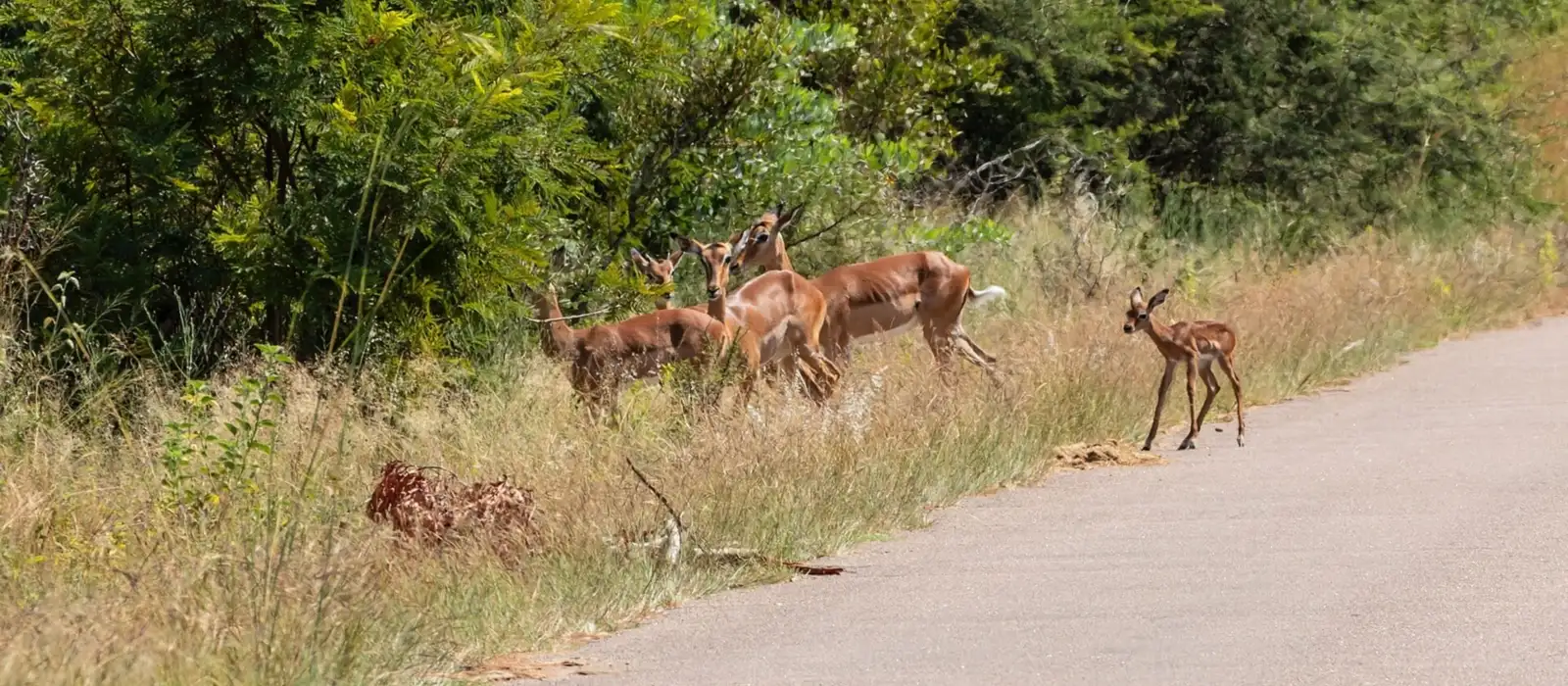
Budget safari in South Africa: choose the park that fits
| Park | Strongest budget fit | Useful access baseline | Main cost advantage | Main limitation |
|---|---|---|---|---|
| Kruger | Several days of independent wildlife viewing | Johannesburg to Malelane Gate about 4–5 hours | Public camps and self-drive roads | Long approach and separate daily fees |
| Addo | A safari within an Eastern Cape road trip | Gqeberha to Main Camp via Paterson 120 km (75 miles), about 1 hour 15 minutes | Short approach and optional paid guiding | Big Seven is not a single land-drive checklist |
| Pilanesberg | A short Johannesburg side trip | Operator baseline about 170 km (106 miles), just over 2 hours | Less road time than a distant safari add-on | Your starting point and gate change the journey |
| Hluhluwe-iMfolozi | A KwaZulu-Natal wildlife segment | Join it to an existing KwaZulu-Natal route | Self-driving is possible | Separate operator and park tariff system |
The cheapest-looking park is not always the cheapest journey. If you already have a car in Gqeberha, Addo can make more sense than buying flights and another rental for Kruger. If you are in Johannesburg with limited time, Pilanesberg reduces the approach. Saving on a room while adding unnecessary transport usually moves spending rather than removing it.
Do not assume that all South African wildlife parks use SANParks rules or accept the same entry products. Kruger and Addo are SANParks parks. Pilanesberg and Hluhluwe-iMfolozi have different management and fee arrangements. Put the correct park’s entry charge into your budget instead of importing a familiar Kruger figure.
A useful first comparison is the cost of adding the safari to the trip you already have. Separate services you would buy anyway, such as a road-trip rental, from services required only by the safari detour. Then compare the extra nights, transport and entry. This prevents a shared vehicle from being counted twice in one option while being omitted entirely from another. The same approach works for food: a self-catering unit changes how you purchase meals, but does not make them free.
Use rest-camp accommodation to control the biggest fixed cost
SANParks accommodation ranges from campsites to furnished units. Your useful choice is between the equipment you bring and the facilities already included. Camping makes the strongest financial sense when the tent, bedding and cooking equipment are already part of your road trip. Hiring or buying everything for a short stay can narrow the saving.
| Accommodation type | What you are choosing | Good fit | Cost trap |
|---|---|---|---|
| Campsite | A place for your own camping equipment | Equipped road trips | Tent and bedding are additional if you do not own them |
| Furnished safari tent | A permanent tented unit | Travelers wanting a bed without a full bungalow | Bathrooms and cooking may be communal |
| Basic bungalow or hut | A built sleeping unit | A simple indoor base | Equipment varies between unit codes |
| Equipped self-catering unit | A private unit with the specified cooking facilities | Travelers preparing their own meals | Larger capacity can cost more even with unused beds |
| Guesthouse or family unit | More space for a party | Families or friends traveling together | Base occupancy and extra-person supplements matter |
At Kruger, Skukuza, Lower Sabie and Satara provide established camp bases. Their different settings affect your drives more than a decorative room upgrade does. The Kruger lodge and rest-camp guide compares the regions without treating all accommodation as a luxury lodge package.
At Addo, Main Camp has camping, safari tents and built accommodation; Matyholweni offers a southern self-catering alternative. Staying inside can make the morning simpler, while an outside base can suit an existing road itinerary. Compare the full quote for your party, including the required accommodation category, rather than a single “from” amount.
SANParks conservation fees with the correct dates
As of November 2026, the following daily fees apply from 1 November 2026 through 31 October 2027. Amounts are per person in rand. Adults are 12 or older; the child column covers ages 2–11. SANParks conservation entry is charged separately from a public-camp room.
| Visitor category | Kruger adult | Kruger child | Addo adult | Addo child |
|---|---|---|---|---|
| South African citizen/resident | R140 | R70 | R115 | R57 |
| Standard SADC national category | R296 | R147 | R242 | R121 |
| Standard international category | R692 | R345 | R565 | R283 |
Eligibility documents and treaty exceptions affect the category charged. Fees are separate from accommodation, and a Wild Card is a conservation-access product rather than a room or meal package. Price any pass against your actual park days and eligibility; there is no reason to buy one simply because it appears in a safari checklist.
For Kruger, Mozambique and Zimbabwe nationals benefit from the park-specific transfrontier agreement category, rather than automatically paying the standard SADC amount. The correct nationality documents therefore matter to both the gate process and the cost calculation.
As of November 2026, SANParks adds a 1% community fund to accommodation and activity reservations, with no published fixed end date. Include it in the calculation instead of treating the published room amount as the invoice total. Conservation fees also recur with the chargeable visit days, so extending a stay changes more than the accommodation line.
A sourced sample daily budget at Addo
This example is for one standard international adult using an existing suitable vehicle and bringing camping equipment. It deliberately prices the park-and-camp part of one day, rather than pretending to be an all-inclusive travel budget. Food, fuel, rental and the approach journey remain separate because there is no fixed rate for those choices.
As of November 2026, Addo’s public accommodation offer displays a tent-site starting price of R537 per night. That is a November 2026 availability-based offer with no stated validity range, not a guaranteed price for every night or party. The optional sedan hop-on guide costs R400 for a 2-hour outing under the tariff effective from 1 March 2026, with no published end date.
| Cost line | Calculation | One adult’s amount |
|---|---|---|
| Standard international conservation fee | 1 adult × R565 | R565.00 |
| Tent site at the displayed starting rate | 1 site × R537 | R537.00 |
| Accommodation community fund | 1% × R537 | R5.37 |
| Self-drive park-and-camp subtotal | R565 + R537 + R5.37 | R1,107.37 |
| Optional sedan hop-on guide | 1 outing × R400 | R400.00 |
| Activity community fund allowance | 1% × R400 | R4.00 |
| Subtotal with the optional guide | R1,107.37 + R404 | R1,511.37 |
The guide component is a vehicle-level charge, not a ticket for an open safari truck. It does not replace conservation fees. The activity levy is included conservatively in the worked allowance because SANParks applies the community fund to activity reservations. Your final invoice determines the exact payable booking total.
For a South African adult using the same site and no paid guide, substituting R115 entry gives a park-and-camp subtotal of R657.37. This arithmetic makes the residency effect visible without changing the accommodation assumption. It does not imply that a foreign visitor can obtain the local entry rate.
Add your actual vehicle quote, planned fuel purchases and meals to either subtotal. Sharing transport can reduce the per-person cost, but the accommodation occupancy must support the group. The Addo safari guide explains the southern gate, Main Camp and game-drive departures in more detail.
What a guided safari day costs in a real comparison
As of November 2026, Crisscross Adventures lists its full-day Addo tour at R2,850 per person, running approximately 08:30–17:30 for 9 hours. Its standard full-day product includes entry, lunch, drinks and snacks, with return transfers from accommodation in its Addo Village collection zone. The lunch braai depends on weather.
That package is a useful comparison for a traveler who does not want to self-drive, but it is not a like-for-like substitute for the campsite subtotal. It includes a vehicle, guiding and lunch; it excludes your accommodation and meals outside the tour. Avoid adding a second conservation ticket when that charge is already included in the quoted excursion.
The operator’s full-day tour details also distinguish its standard vehicle tour from open-vehicle products. A photograph of an open safari vehicle does not mean every departure uses that format. Compare the actual product, collection area and included services before deciding that an excursion is unusually cheap or expensive.
For a solo traveler, a shared guided excursion can simplify transport. For several adults already sharing a rental, self-driving may spread the vehicle cost more effectively. Neither approach is automatically the bargain; the strongest option depends on what you already need for the rest of the trip.
Four parks, four sensible ways to save
Kruger: stay in one region long enough to use it
The journey from Malelane Gate to Berg-en-Dal is only 12 km (7.5 miles), around 30 minutes, while Orpen Gate to Satara is 48 km (30 miles), around 2 hours. Phalaborwa Gate to Letaba is 51 km (32 miles), also around 2 hours. Camp position determines how much of the day you spend relocating.
Choose a compact circuit instead of attempting the full park. A short distance at wildlife-viewing speed can be a worthwhile outing; a long transfer driven to meet a deadline is a different experience. Base changes have a time cost even when no operator charges a transfer fee.
Addo: use the entrance that matches your base
Gqeberha to Matyholweni is about 45 km (28 miles), around 30 minutes. Main Camp is about 120 km (75 miles), around 1 hour 15 minutes, via the recommended Paterson approach. As of November 2026, use the N2 via Colchester rather than the R335 through Motherwell because of the approach-road security warning. The southern entrance can therefore work well for a city-based day trip, while Main Camp is useful when a booked activity departs there.
Main Camp to Matyholweni through the wildlife area is about 39 km (24 miles), with around 2 hours allowed for viewing. Do not treat the internal route as a fast shortcut to a timed booking. Select the gate for the day’s plan, then enjoy the drive rather than racing through it.
Pilanesberg: save approach time from Johannesburg
Pilanesberg lies in North West province near Sun City. Its tour operator’s directions give a roughly 170 km baseline from Johannesburg, with just over 2 hours to the gates. Traffic, your address and the chosen entrance can lengthen that journey, so leave room for the drive onward to your accommodation.
It is a practical alternative when a Kruger approach would consume too much of a short break. The saving is partly in time and road distance, rather than a promise that every lodge is inexpensive. Keep park entry and any guided drive separate in your comparison.
Hluhluwe-iMfolozi: combine it with KwaZulu-Natal
Hluhluwe-iMfolozi spans about 96,000 hectares, or 960 km², and offers self-drive as well as guided wildlife viewing. It is a relevant alternative when KwaZulu-Natal already forms part of the itinerary. Adding it to a trip on the other side of the country changes the transport calculation.
Its Big Five wildlife and rhino conservation significance make it more than a low-cost substitute for Kruger. Treat it as a destination choice with its own management, accommodation and tariffs. The SANParks fee table above does not apply there.
Keep savings practical, with a short booking checklist
Kruger’s April–September dry season gives thinner vegetation and cooler nights; October–March is hotter and wetter. Choose dates that suit the wildlife experience you want before searching for discounts. A promotional room rate during a difficult transfer schedule may not save much overall.
As of November 2026, South Africa’s official travel advice identifies vehicle crime, including risks after dark. Plan road journeys in daylight, stay on sensible main routes and confirm the current government guidance before travel. See a travel clinic for region-specific health planning; accommodation tier does not change the destination’s health conditions.
- Choose the park already closest to your broader route.
- Compare a particular campsite or unit code for the whole party.
- Add conservation fees, levies, meals and actual vehicle costs.
- Separate an optional guided outing from a compulsory package.
- Match camp location to arrival and departure days.
Use the South Africa rental guide for the transport side and the first safari cost guide for tours and agent arrangements. Spend on the services you need, then remove duplication: a second transfer, an unused meal package or a room upgrade that adds nothing to your wildlife days.
Frequently asked questions
What is the cheapest way to do a safari in South Africa?
For travelers who already have a suitable car and camping equipment, self-driving and camping can keep paid services limited. Rental, fuel, food and conservation fees still belong in the comparison, so a campsite price is not the cost of the whole trip.
Are affordable South African safari lodges available?
SANParks camps offer furnished tents, bungalows and other self-catering units as alternatives to luxury packages. Compare the specific unit facilities and party total instead of assuming every camp has the same accommodation.
Is Kruger cheaper than a private safari reserve?
It can be, especially when several people share a self-drive car and accommodation. Private packages include services that you would otherwise pay for separately, so compare meals, guiding, transfers and fees before judging the difference.
Which safari is easiest to add to Johannesburg?
Pilanesberg is a practical short-road-trip option, with an operator route baseline of about 170 km and just over two hours to the gates. The exact journey depends on your starting point and entrance.
Does a budget safari still offer worthwhile wildlife viewing?
Yes. Public parks allow wildlife viewing without a luxury lodge booking. Animals remain wild, and neither a low-cost self-drive nor an expensive guided package guarantees the Big Five.
Sources
- SANParks - Conservation fee schedule, 2026–27 sanparks.org
- SANParks - Rates, fees and community fund sanparks.org
- SANParks - Kruger accommodation categories sanparks.org
- SANParks - Kruger main rest camps sanparks.org
- SANParks - Kruger travel distances sanparks.org
- SANParks - Addo current accommodation offers sanparks.org
- SANParks - Addo game drives and hop-on guide rates sanparks.org
- SANParks - Addo accommodation sanparks.org
- SANParks - Addo directions and distances sanparks.org
- Pilanesberg National Park operator - Directions and distances pilanesbergnationalpark.org
- KwaZulu-Natal Tourism and Film - Hluhluwe-iMfolozi game drives visitkzn-sa.com
- Crisscross Adventures - Full-day Addo tour and inclusions crisscrossadventures.co.za
- SANParks - Kruger climate sanparks.org
- UK Government - South Africa safety and security gov.uk