Kenya vs South Africa at a glance
| Decision | Kenya | South Africa |
|---|---|---|
| Typical first safari plan | A guided park or conservancy stay | Self-drive Kruger or a guided lodge |
| Daily driving | Often handled by a driver-guide | Can be independent or included |
| Main wildlife starting point | Maasai Mara or another selected park | Kruger or a selected private reserve |
| Beach extension | Diani or another coast base | A coast stay chosen by region |
| City extension | Nairobi or a coastal historic city | Cape Town or Johannesburg |
| Budget question | Private versus shared guiding and access | Self-drive total versus lodge package |
| Health planning | Route-specific malaria and other advice | Route-specific advice, including Kruger |
| Entry planning | Authorization and insurance eligibility | Passport-specific rules and onward route |
Kenya is in East Africa. South Africa is a separate country at the continent’s southern end. Treat any combination of them as an international itinerary with additional flights and entry checks.
Safari style and the first-day experience
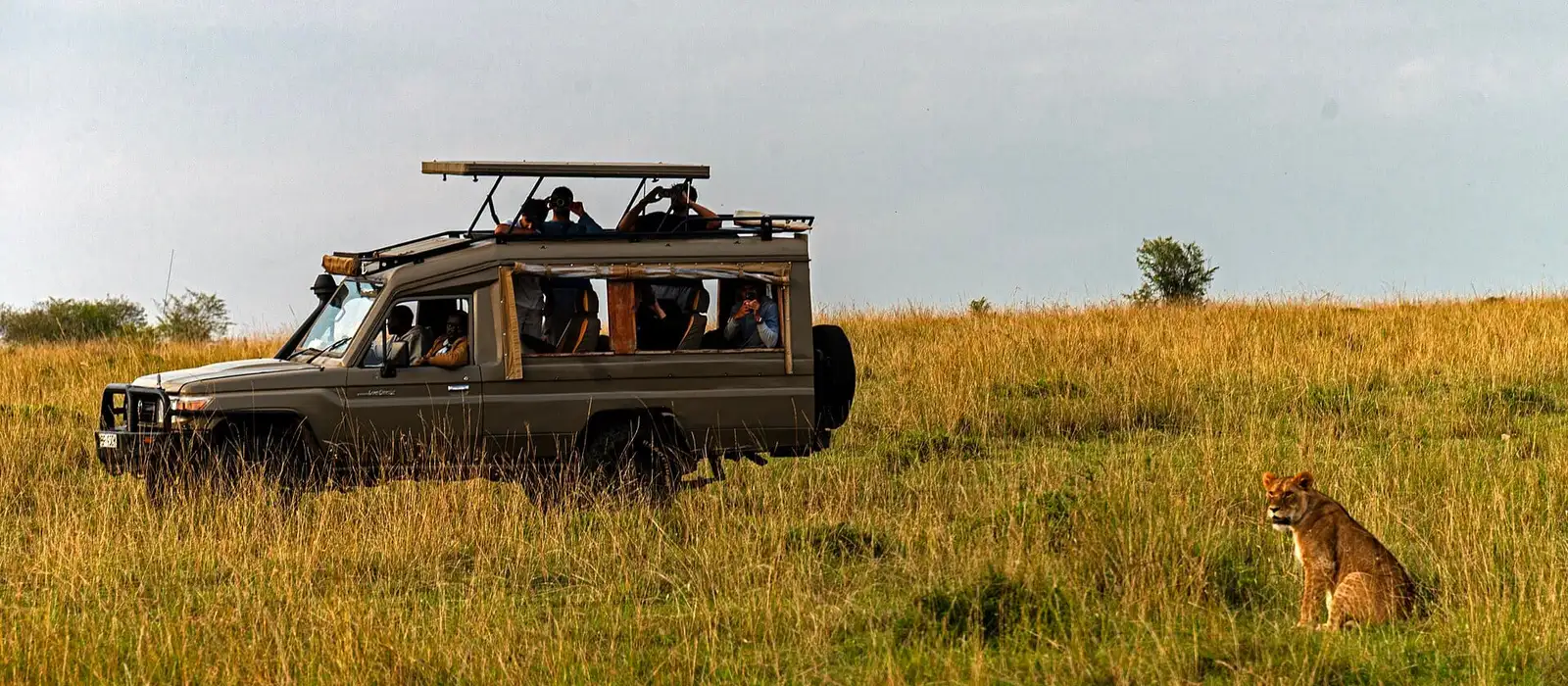
Kenya is a good match if you want a guide to manage the wildlife day from the beginning. A driver-guide can choose the route, interpret animal behavior and handle the practical rhythm of a park visit. You still need to choose the right base.
The Maasai Mara, Amboseli and Tsavo offer different settings and routes. Avoid choosing a safari solely because the brochure lists several well-known parks.
SANParks visitor guidance describes rest-camp facilities and slow travel through the park. A self-drive stay means handling your own daily route, meals and timing.
A private lodge is another South African option. Compare its drive arrangements, meal plan and access area with the independent itinerary. Country alone does not determine how much assistance or privacy you receive.
Wildlife and choosing a base
A room near a park boundary can be a practical choice for one route and inconvenient for another.
For Kenya, compare the reserve or park with any conservancy named in the quote. Different arrangements can change the daily experience even within the same broad destination.
For Kruger, allow time to remain in one area rather than continuously moving camps. You can choose a second base when it creates a worthwhile contrast. The transfer should still allow enough time to enjoy the place where you finish.
Neither country can guarantee a particular sighting. Build a trip around several wildlife outings and an interest in the wider landscape. The Kenya places guide helps compare Kenya’s different park and coast choices.
Amboseli’s elephant-viewing plains and Kilimanjaro backdrop offer a different setting from the Mara’s rolling grasslands. Kruger has 12 main rest camps, giving an independent traveler a choice of serviced bases rather than a requirement to buy a private-lodge package. Skukuza and Lower Sabie suit a southern circuit; Satara adds a more central grassland base. A move between them should be a slow safari day, not a fast road transfer.
Self-drive versus guided travel
Kruger’s main rest camps provide fuel and, at most camps, shops and restaurants. That supports an independent stay in which you choose the route and return to your own booked camp. Meals are separate from SANParks accommodation tariffs, and the slow park roads need more time than the outside highway.
Kenya’s guided road model puts the driver-guide in charge of navigation and wildlife interpretation. A Mara reserve itinerary and a conservancy itinerary can use different access areas, while a private vehicle keeps the day’s pace with your party. A shared departure distributes the vehicle cost but also shares decisions about stops. Those are service differences rather than automatic consequences of the country name.
Costs and the whole-trip comparison
The national park charges differ enough to change the result of a whole-trip comparison. As of November 2026, Maasai Mara National Reserve charges non-resident adults USD100 per person per day in January-June and USD200 in July-December. Non-resident children aged 9-17 pay USD50, while children aged eight and younger enter free. These are reserve charges set by Narok County, separate from neighboring conservancy arrangements.
As of November 2026, Kruger’s international conservation fee is R692 adult and R345 child daily, valid November 1, 2026-October 31, 2027; adult means 12+, child 2-11. Accommodation and vehicle costs are extra. South African citizen/resident and SADC categories remain separate.
Three adult Mara reserve days therefore total USD300 in the first half of the year or USD600 in the second half, before the room, guide and vehicle. That arithmetic explains why two superficially similar Kenya quotes can differ sharply by month. A conservancy-only day uses its own access arrangements rather than automatically adding a reserve visit.
Kenya’s guided model often combines accommodation, driver and vehicle in one quote. Kruger self-drive separates the rental, fuel, food and conservation charges, while a private lodge bundles more services. A fair comparison uses the same travelers, nights and vehicle privacy. The first-safari planning guide explains the supplier-commission and separately charged planning models.
Beaches and city extensions
Kenya works well when you want a coast stay after a safari. Diani provides a south-coast beach base, while Mombasa adds Old Town and Fort Jesus. Choose the coast according to the actual room, transfer and activities you want.
The Diani travel guide covers arrival points and beach areas. Keep a flexible water day because tides, wind and current affect individual outings. A beach extension should leave enough nights after the journey to justify the move.
South Africa can combine wildlife with Cape Town’s city, mountain and peninsula. That is a distinct travel portion with its own weather and transport. Choose a longer city stay if the mountain or coastal outdoors are important.
For an Indian Ocean city-and-coast stay, compare Durban and its surrounding region against your desired route.
Seasons and choosing travel dates
The Mara’s main migration-focused window is July-October, with a separate January-February drier period for resident wildlife. June-August afternoons are around 25°C (77°F), and mornings near 12°C (54°F). March-May brings the long rains and can affect tracks.
Kruger’s broad dry window is April-September. June-August afternoons are around 25°C (77°F), with cold early drives, while December-February afternoons commonly reach around 33°C (91°F) with summer storms. Cape Town has winter rain during the safari dry season. A July wildlife-and-city holiday therefore has different weather at its two bases, while Kenya’s coast also needs a separate seasonal choice.
Access and the last transfer
London-Nairobi takes about eight hours 35 minutes nonstop; New York JFK-Nairobi takes roughly 13.5-15 hours, depending on the scheduled service. London-Johannesburg takes about 11 hours, while Newark-Johannesburg is around 14 hours 45 minutes to 15 hours five minutes. Nairobi uses UTC+3; South Africa uses UTC+2, both without seasonal clock changes. Flight durations below exclude airport procedures and the city transfer between Nairobi’s international airport and Wilson.
| From city to wildlife area | Road distance | Typical road allowance | Fly-in alternative |
|---|---|---|---|
| Nairobi-Maasai Mara nearest gate | About 270 km / 168 miles | About 4-5 hours before the camp approach | Wilson to Mara strip roughly 45-80 minutes |
| Nairobi-Amboseli, via Namanga and Meshanani | About 220 km / 137 miles | Around 4 hours | Wilson to Amboseli on scheduled light aircraft |
| Johannesburg-Malelane Gate, Kruger | 428 km / 266 miles | Around 5-6 hours | Johannesburg-Skukuza about 1 hour |
| Johannesburg-Phabeni Gate, Kruger | 430 km / 267 miles | Around 5-6 hours | Kruger Mpumalanga flight, then road to the gate |
| Johannesburg-Orpen Gate, Kruger | 490 km / 304 miles | Around 6 hours | Hoedspruit flight, then road transfer |
The Mara road figure ends at the nearest reserve gate rather than at every camp. Likewise, arriving at a Kruger gate leaves slow game-viewing roads to the overnight rest camp. A fly-in Kenya plan uses a specific airstrip: Keekorok, Ol Kiombo and Mara Serena are not interchangeable arrival points. Skukuza Airport is inside Kruger, while Hoedspruit and Kruger Mpumalanga are outside the park and serve different approaches.
Cape Town-Skukuza takes about two hours 25 minutes in that direction, a useful bridge between the city and safari blocks. Kenya’s coast extension also requires a separate flight or road stage; the room in Diani is reached through Ukunda or Mombasa rather than through a Mara airstrip.
Entry requirements, safety and health
As of November 2026, UK entry guidance for Kenya says most visitors staying under 12 months need Kenyan government travel health insurance. If you need a new electronic travel authorization, buy the insurance during the application. With an existing valid authorization, use the eCitizen insurance portal. Check exemptions for residence, nationality or airside transit before you pay.
As of November 2026, CDC’s Kenya guidance identifies malaria risk across many lower-elevation areas, including game parks. Its South Africa chapter identifies Kruger as a risk area and maps Cape Town outside known transmission areas. Take the full itinerary to a travel clinic.
Health planning should include the coast and any overnight city stops.
As of November 2026, the standard Kenya eTA starts at USD30, excluding payment charges and any required insurance. Normal processing is generally within three business days, although the official travel guidance recommends applying at least two weeks before departure. The separate Kenyan government health policy is valid for 90 days and multiple entries within that period. Eligibility and exemptions depend on nationality and residence, so the eTA amount is not a universal entry charge for every visitor.
Choose Kenya if
Choose Kenya if the safari is the main reason for travel and you want a guided trip followed by the Indian Ocean. Begin with one wildlife base that matches your interests. Add another only when its setting or activities justify the journey.
Give the coast enough nights to change the pace after the safari. Keep a flexible day for the outing most affected by sea conditions.
For a broader East African choice, the South Africa–Tanzania comparison provides another way to judge a guided wildlife-and-island itinerary.
Choose South Africa if
Choose South Africa if you want the option to drive yourself and combine wildlife with a substantial city stay. Decide early between an independent park route and a guided lodge. Price the full arrangements before selecting the flights.
Keep Kruger and Cape Town in separate blocks with their own transfer time. Choose fewer bases if the first draft leaves little time at either.
Frequently asked questions
Is Kenya in South Africa?
Kenya and South Africa are separate countries. Kenya is in East Africa, while South Africa lies at the southern end of the continent.
Is Kenya or South Africa better for a first safari?
Kenya suits a guided wildlife trip with a coast extension. Kruger in South Africa offers self-drive rest-camp stays as well as guided lodge options.
What are the Maasai Mara and Kruger entrance fees?
As of November 2026, the Mara non-resident adult fee is USD100 daily in January-June and USD200 in July-December. Kruger's international adult fee is R692 daily for November 1, 2026-October 31, 2027; children and eligible resident categories differ.
How much does a Kenya eTA cost?
As of November 2026, the standard eTA starts at USD30 before payment charges and any required insurance. Passport and residence exemptions mean that the same application requirement does not apply to every visitor.
Can you avoid malaria-risk areas in South Africa?
A route based on Cape Town can remain outside known transmission areas, but Kruger is a malaria-risk area. Take the full park-and-city itinerary to a travel clinic.
Sources
- SANParks – visitor tips sanparks.org
- SANParks – climate sanparks.org
- Kenya Tourism Board – migration magicalkenya.com
- FCDO – Kenya entry requirements gov.uk
- FCDO – Kenya safety gov.uk
- FCDO – South Africa safety gov.uk
- CDC – Kenya wwwnc.cdc.gov
- CDC – South Africa cdc.gov
- South African Tourism – Durban coast southafrica.net
- National Museums of Kenya – Fort Jesus museums.or.ke
- Discover Pwani – Diani pwani.co.ke
- Cape Town Tourism – places for first-time visitors capetown.travel
- SANParks - Johannesburg gate distances and access hours sanparks.org
- SafariBookings and WorldClim - Kruger climate data safaribookings.com
- SafariBookings and WorldClim - Maasai Mara climate data safaribookings.com
- British Airways - London to Nairobi flight duration britishairways.com
- British Airways - London to Johannesburg flight duration britishairways.com
- Directflights - Newark to Johannesburg schedule duration directflights.com
- Kenya Immigration - eTA categories and USD fees extern.api.etakenya.go.ke
- Kenya Immigration - eTA fees and processing etakenya.go.ke
- Narok County Finance Act 2023 - reserve fee schedule, pages 4 and 12 narok.go.ke
- Go2Africa - Nairobi to Maasai Mara road distance go2africa.com
- Kenya Wildlife Service - Amboseli access routes kws.go.ke
- Airlink Skukuza Airport - scheduled flight durations skukuzaairport.flyairlink.com
- Safarilink - Maasai Mara airstrips and services flysafarilink.com
- FlightConnections - New York JFK to Nairobi duration flightconnections.com
- SANParks - Johannesburg driving times and camp distances sanparks.org